Εμφάνιση αναρτήσεων με ετικέτα Middle East. Εμφάνιση όλων των αναρτήσεων

Τρίτη 9 Σεπτεμβρίου 2014

Israel, Turkey exchange diplomatic cold shoulders

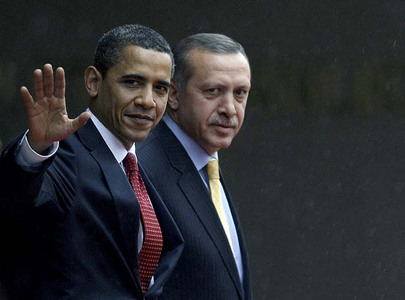
Turkey's Erdogan pinpointing the villain
The State of Israel was not among the more than 90 countries that sent a representative to the festive Aug. 27 inauguration ceremony of Turkey’s 12th president, Recep Tayyip Erdogan, officially named the most powerful man in the country’s history since the founder of the republic, Mustafa Kemal Ataturk. Nor could a message from Jerusalem be found among the many dozens of congratulatory telegrams that arrived in Ankara to mark the event.
Erdogan’s crude attacks on Israel during his campaign coincided with the fighting against Hamas in Gaza. Israel must also have noticed that Turkey completely ignored its own presidential inauguration one month earlier, when Reuven Rivlin took the oath of office July 24.
I can testify that Rivlin is an enthusiastic supporter of mending the relationship between Israel and Turkey (as was his predecessor, former President Shimon Peres). Even in the midst of his presidential campaign, he had no qualms about stating so publicly. While there was somewhat more optimism then about the possibility of improving ties with Turkey, it was still not considered a very popular move.
It is safe to assume that Rivlin would have happily accepted the invitation sent by the Turkish government to the Israeli Embassy in Ankara to send an official representative to the inauguration if he had thought it would provide the momentum to break away from the crisis.
Two days later, Erdogan hosted all the senior diplomats in Turkey at a traditional reception to mark “Victory Day.” He even shook hands with the official Israeli representative and exchanged a few polite words with him. That representative was the charge d’affaires Yossi Levy-Sfari, the most senior Israeli diplomat in Ankara since Erdogan and Ahmet Davutoglu (then foreign minister and now prime minister) downgraded diplomatic relations between the two countries, recalled the Turkish ambassador and other senior embassy officials in Tel Aviv and expelled top Israeli representatives from Ankara.
It was the first time that Erdogan shook hands with an official Israeli representative since the Davos incident in 2009, when he lashed out at then-President Shimon Peres over the killing of Palestinians in Gaza during Operation Cast Lead.
In Jerusalem, the Foreign Ministry expressed a measured degree of satisfaction that Erdogan did not prevent an invitation to the inauguration from being sent to the Israeli mission in Ankara. At the same time, however, the ministry avoided attributing a hidden or symbolic meaning to this nongesture. After all, relations between the two countries reached an unprecedented low following Erdogan’s comparison of Israel to Nazi Germany during Operation Protective Edge.
Diplomatic sources in Israel are frustrated by what they call Turkish ingratitude toward Israel after it allowed the country to provide humanitarian aid to Gaza, despite Erdogan's tongue lashing.
The few Israeli diplomats who remained in Turkey were kept very busy during the fighting in Gaza. They were not only tasked with explaining Israel’s positions — an essentially meaningless exercise in Erdogan’s Turkey — but even more importantly, with helping the Turkish government provide aid to the civilian population in Gaza. At the height of the fighting, Davutoglu announced an “airlift” of humanitarian aid from the Turks to Gaza.
An airlift is a beautiful idea, but as everybody knows, there is no airport in Gaza that can accept such a delivery — or a seaport, for that matter. Sending the aid via Egypt wasn’t an option, either, due to tensions between Cairo and Ankara. As such, the only way that Turkey could provide its emergency aid in the face of what it considered “diabolical Israeli violence” was through Israel itself.
And so, even while Erdogan continued to attack Israel in less than diplomatic language, transport planes from the Turkish air force were granted permission to land at Ben Gurion Airport. These planes carried tons of equipment and supplies intended for the people of Gaza.
According to figures provided by the Turkish Cooperation and Coordination Agency, Turkey provided thousands of meals to families in Gaza during Ramadan. As the fighting continued, that same agency provided 12 truckloads of medical and sanitation supplies to Gaza in the name of the Turkish people. The trucks passed from Israel to Gaza through the Kerem Shalom border crossing. The coordinator of Israel Defense Forces (IDF) activities in the territories told Al-Monitor that at the request of Turkish representatives in Gaza, these trucks contained “medicine and medical equipment as well as school bags, oil, toothpaste, garbage bags, canned tuna, disposable diapers, women’s sanitary pads, laundry detergent and towelettes.”
The C-130 Hercules transport planes of the Turkish military then flew back from Ben Gurion Airport to Turkey carrying a group of Palestinians from Gaza who had been wounded in the Israeli air raids. Each transportee was carefully selected to receive medical treatment in Turkey. So far, the Foreign Ministry in Jerusalem has been working to approve the departure of dozens of injured Gazans and their escorts to Turkey, based on a detailed list provided by the Turks.
The decision to allow Turkey to provide humanitarian aid to Gaza at the height of the campaign should not be taken lightly. It was made despite opposition from those who believed that Erdogan did not deserve such a gesture from Israel while he attacked Israel and its leaders. In the end, it was decided to allow the aid as a gesture of goodwill, with the intention — or perhaps the hope — of improving relations between the two countries in some small way.
But good intentions were not enough. Jerusalem was surprised to read reports and telegrams arriving from Ankara, indicating that Erdogan was not only continuing with his diatribes against the Israeli government, but that Davutoglu also contributed to the vitriol. In his appearances before various forums, Davutoglu described efforts to provide aid to Israel as a Sisyphean task, working against Israel’s fervent opposition. He went on to say that Israel was doing everything it could to make it difficult for Turkey to provide aid to Gaza.
As part of the changes underway in Turkey, Erdogan chose Davutoglu to be his prime minister. Turkish officials involved in the relationship between the two countries estimate that it will be very difficult if not impossible to get back on the track of normalization between the two countries, mainly because Turkey is facing yet another election in 2015 (this one for parliament). Erdogan and Davutoglu, they say, both believe that their anti-Israel approach will win lots of votes.
One person who maintains a certain degree of optimism about the relationship between the two countries is the head of the Israel-Turkey Business Council, Menashe Carmon. In a conversation with Al-Monitor, he said Turkish businessmen tend to avoid politics. This year, trade between the two countries will amount to $5 billion (in 2011 it was $4 billion, and $1.5 billion in 2005), and the only threat he mentioned was the possibility of an economic crisis in Turkey. Furthermore, he emphasized that Turkey is not like Europe in that there are no calls there for a boycott of Israel. Quite the contrary, he pointed out, it is Israelis who are boycotting Turkish products. As a result of Erdogan’s statements and policies, many Israelis canceled their summer vacation reservations in Turkey and workers committees have announced that they will not be purchasing vacation packages there, at least in the foreseeable future.
Turkey will manage without Israeli tourists, who made up just 2% of visitors to the country in 2010. Israel emphasizes, though, that the real culprit in this ongoing crisis is Erdogan, who insists on foregoing any chance he may have had to have a real impact on the fate of the people he calls “his Palestinian brothers.” Had he conducted his affairs differently, he could have really helped the suffering people of Gaza with more than just garbage bags and canned goods.


Τρίτη 12 Αυγούστου 2014

Turkey's Geographical Ambition

STRATFOR - Geopolitical Weekly TUESDAY, AUGUST 12, 2014 


At a time when Europe and other parts of the world are governed by forgettable mediocrities, Recep Tayyip Erdogan, Turkey's prime minister for a decade now, seethes with ambition. Perhaps the only other leader of a major world nation who emanates such a dynamic force field around him is Russia's Vladimir Putin, with whom the West is also supremely uncomfortable.
Erdogan and Putin are ambitious because they are men who unrepentantly grasp geopolitics. Putin knows that any responsible Russian leader ensures that Russia has buffer zones of some sort in places like Eastern Europe and the Caucasus; Erdogan knows that Turkey must become a substantial power in the Near East in order to give him leverage in Europe. Erdogan's problem is that Turkey's geography between East and West contains as many vulnerabilities as it does benefits. This makes Erdogan at times overreach. But there is a historical and geographical logic to his excesses.
The story begins after World War I.
Because Ottoman Turkey was on the losing side of that war (along with Wilhelmine Germany and Hapsburg Austria), the victorious allies in the Treaty of Sevres of 1920 carved up Turkey and its environs, giving territory and zones of influence to Greece, Armenia, Italy, Britain and France. Turkey's reaction to this humiliation was Kemalism, the philosophy of Mustafa Kemal Ataturk (the surname "Ataturk" means "Father of the Turks"), the only undefeated Ottoman general, who would lead a military revolt against the new occupying powers and thus create a sovereign Turkish state throughout the Anatolian heartland. Kemalism willingly ceded away the non-Anatolian parts of the Ottoman Empire but compensated by demanding a uniethnic Turkish state within Anatolia itself. Gone were the "Kurds," for example. They would henceforth be known as "Mountain Turks." Gone, in fact, was the entire multicultural edifice of the Ottoman Empire.
Kemalism not only rejected minorities, it rejected the Arabic script of the Turkish language. Ataturk risked higher illiteracy rates to give the language a Latin script. He abolished the Muslim religious courts and discouraged women from wearing the veil and men from wearing fezzes. Ataturk further recast Turks as Europeans (without giving much thought to whether the Europeans would accept them as such), all in an attempt to reorient Turkey away from the now defunct Ottoman Empire in the Middle East and toward Europe.
Kemalism was a call to arms: the martial Turkish reaction to the Treaty of Sevres, to the same degree that Putin's neo-czarism was the authoritarian reaction to Boris Yeltsin's anarchy of 1990s Russia. For decades the reverence for Ataturk in Turkey went beyond a personality cult: He was more like a stern, benevolent and protective demigod, whose portrait looked down upon every public interior.
The problem was that Ataturk's vision of orienting Turkey so firmly to the West clashed with Turkey's geographic situation, one that straddled both West and East. An adjustment was in order. Turgut Ozal, a religious Turk with Sufi tendencies who was elected prime minister in 1983, provided it.
Ozal's political skill enabled him to gradually wrest control of domestic policy and -- to an impressive degree -- foreign policy away from the staunchly Kemalist Turkish military. Whereas Ataturk and the generations of Turkish officers who followed him thought in terms of a Turkey that was an appendage of Europe, Ozal spoke of a Turkey whose influence stretched from the Aegean to the Great Wall of China. In Ozal's mind, Turkey did not have to choose between East and West. It was geographically enshrined in both and should thus politically embody both worlds. Ozal made Islam publicly respected again in Turkey, even as he enthusiastically supported U.S. President Ronald Reagan during the last phase of the Cold War. By being so pro-American and so adroit in managing the Kemalist establishment, in the West at least Ozal -- more than his predecessors -- was able to get away with being so Islamic.
Ozal used the cultural language of Islam to open the door to an acceptance of the Kurds. Turkey's alienation from Europe following the 1980 military coup d'etat enabled Ozal to develop economic linkages to Turkey's east. He also gradually empowered the devout Muslims of inner Anatolia. Ozal, two decades before Erdogan, saw Turkey as a champion of moderate Islam throughout the Muslim world, defying Ataturk's warning that such a Pan-Islamic policy would sap Turkey's strength and expose the Turks to voracious foreign powers. The term neo-Ottomanism was, in fact, first used in Ozal's last years in power.
Ozal died suddenly in 1993, ushering in a desultory decade of Turkish politics marked by increasing corruption and ineffectuality on the part of Turkey's sleepy secular elite. The stage was set for Erdogan's Islamic followers to win an outright parliamentary majority in 2002. Whereas Ozal came from the center-right Motherland Party, Erdogan came from the more openly Islamist-trending Justice and Development Party, though Erdogan himself and some of his advisers had moderated their views over the years. Of course, there were many permutations in Islamic political thought and politics in Turkey between Ozal and Erdogan, but one thing stands clear: Both Ozal and Erdogan were like two bookends of the period. In any case, unlike any leader today in Europe or the United States, Erdogan actually had a vision similar to Ozal's, a vision that constituted a further distancing from Kemalism.
Rather than Ataturk's emphasis on the military, Erdogan, like Ozal, has stressed the soft power of cultural and economic connections to recreate in a benign and subtle fashion a version of the Ottoman Empire from North Africa to the Iranian plateau and Central Asia. Remember that in the interpretation of one of the West's greatest scholars of Islam, the late Marshall G.S. Hodgson of the University of Chicago, the Islamic faith was originally a merchants' religion, which united followers from oasis to oasis, allowing for ethical dealing. In Islamic history, authentic religious connections across the Middle East and the Indian Ocean world could -- and did -- lead to wholesome business connections and political patronage. Thus is medievalism altogether relevant to the post-modern world.
Erdogan now realizes that projecting Turkey's moderate Muslim power throughout the Middle East is fraught with frustrating complexities. Indeed, it is unclear that Turkey even has the political and military capacity to actualize such a vision. To wit, Turkey may be trying its best to increase trade with its eastern neighbors, but it still does not come close to Turkey's large trade volumes with Europe, now mired in recession. In the Caucasus and Central Asia, Turkey demands influence based on geographic and linguistic affinity. Yet Putin's Russia continues to exert significant influence in the Central Asian states and, through its invasion and subsequent political maneuverings in Georgia, has put Azerbaijan in an extremely uncomfortable position. In Mesopotamia, Turkey's influence is simply unequal to that of far more proximate Iran. In Syria, Erdogan and his foreign minister, Ahmet Davutoglu, thought -- incorrectly, it turns out -- that they could effectively mold a moderate Islamist Sunni opposition to replace President Bashar al Assad's Alawite regime. And while Erdogan has gained points throughout the Islamic world for his rousing opposition to Israel, he has learned that this comes at a price: the warming of relations between Israel and both Greece and the Greek part of Cyprus, which now permits Turkey's adversaries in the Eastern Mediterranean to cooperate in the hydrocarbon field.
The root of the problem is partly geographic. Turkey constitutes a bastion of mountains and plateau, inhabiting the half-island of the Anatolian land bridge between the Balkans and the Middle East. It is plainly not integral to a place like Iraq, for example, in the way that Iran is; and its Turkic language no longer enjoys the benefit of the Arabic script, which might give it more cultural leverage elsewhere in the Levant. But most important, Turkey is itself bedeviled by its own Kurdish population, complicating its attempts to exert leverage in neighboring Middle Eastern states.
Turkey's southeast is demographically dominated by ethnic Kurds, who adjoin vast Kurdish regions in Syria, Iraq and Iran. The ongoing breakup of Syria potentially liberates Kurds there to join with radical Kurds in Anatolia in order to undermine Turkey. The de facto breakup of Iraq has forced Turkey to follow a policy of constructive containment with Iraq's Kurdish north, but that has undermined Turkey's leverage in the rest of Iraq -- thus, in turn, undermining Turkey's attempts to influence Iran. Turkey wants to influence the Middle East, but the problem is that it remains too much a part of the Middle East to extricate itself from the region's complexities.
Erdogan knows that he must partially solve the Kurdish problem at home in order to gain further leverage in the region. He has even mentioned aloud the Arabic word, vilayet, associated with the Ottoman Empire. This word denotes a semi-autonomous province -- a concept that might hold the key for an accommodation with local Kurds but could well reignite his own nationalist rivals within Turkey. Thus, his is a big symbolic step that seeks to fundamentally neutralize the very foundation of Kemalism (with its emphasis on a solidly Turkic Anatolia). But given how he has already emasculated the Turkish military -- something few thought possible a decade ago -- one should be careful about underestimating Erdogan. His sheer ambition is something to behold. While Western elites ineffectually sneer at Putin, Erdogan enthusiastically takes notes when the two of them meet.


Read more: Turkey's Geographical Ambition | Stratfor
Follow us: @stratfor on Twitter | Stratfor on Facebook

Δευτέρα 7 Μαΐου 2012

The Empire Strikes Back: A New Ottoman State in the Middle East?

What had been hidden in Turkey's behavior vis-à-vis the events in the Arab World has now become clear. What had been subjected to analysis and to drawing conclusions has now become an openly declared policy. This was made clear by Foreign Minister Ahmet Davutoglu during a parliamentary discussion last week, in which he said that "a new Middle East is about to be born. We will be the owner, pioneer and the servant of this new Middle East".
 The theorist of Neo-Ottomanism is relying on people rising up against their governments in order to reshape the region. The regimes that have fallen represented an obstacle to his ambitions, and what remains of them is either threatened with collapse or tied down by its weakness and lack of vision. To assert this, he told those who opposed him in parliament: "Go to Cairo. Go to Tripoli. Go to the streets of Beirut, Tunisia, Jerusalem, and ask about Turkey's policy on Syria. They will hug you and express their appreciation for Turkey's honorable policy". He also adds that "We will manage the wave of change in the Middle East. Just as the ideal we have in our minds about Turkey, we have an ideal of a new Middle East. We will be the leader and the spokesperson of a new peaceful order".
Davutoglu speaks with complete confidence in the name of Arab peoples in the Maghreb and in the Levant, on the basis of Turkey's alliance with the new forces in Tunisia, Libya and Egypt, and of its position in the North Atlantic Alliance (NATO) and with the United States. It is a position that cannot be taken lightly, its progression hindered only by the reality in Syria, which had tried throughout the past years to be a main regional power.
The history of the Ottoman Empire, which Davutoglu read well before formulating his theory of Neo-Ottomanism, tells that Sultan Suleiman I (Suleiman the Magnificent) defeated the Safavids and advanced into the Levant, where he also defeated the Mamluks at the battle of Marj Dabek, then headed to Egypt and conquered all the lands of the Arabs. And here is the new sultan, returning to his history and fighting Iran in Syria, after having lost a battle in Iraq, hoping to set off from there to the remaining Arab countries to spread his Islamist model of rule.
And here we are again, peoples and tribes quarreling amongst themselves, some being led by Ankara and others being led by Tehran. Talk of Arabs and Arabism has disappeared, having become "empty rhetoric", as claim intellectuals who see the utmost modernity in the return to sects and confessions. The struggle over and in Syria exceeds the struggle of those who have risen up against oppression, who aspire to freedom and democracy (as important and necessary as those values are).
It is a struggle for control over the entire Middle East, its location and its wealth. And the greatest evidence of this is that those who have joined the uprisings are trying to restore the darkest manifestations of history. The future of the region is being shaped by renewed ancient empires. As for its peoples and its governments, they are tied to this or that new power. And when they rise up, their dreams and ambitions are stolen from them, and they are sent back to the barns of bearded ideology to be tamed all over again.
http://www.albawaba.com/behind-news/ottoman-middle-east-neo-ottomanism-turkey-424059
http://geopolitics-gr.blogspot.com/2012/05/empire-strikes-back-new-ottoman-state.html

Σάββατο 7 Μαΐου 2011

Arab Spring, Turkish Fall

Turkey's leaders are looking less like the new Ottomans they've imagined themselves to be and more like stumbling politicians afraid of a new regional order.  

Steven A. Cook  
The Foreign Policy 
05/05/2011  
Turkish help to Arab stability is on the way
The Arab uprisings seemed tailor-made for the "new Turkey" to exert its much-vaunted influence in the Middle East. Since the Justice and Development Party (AKP) came to power almost nine years ago, Ankara has actively courted the region, cultivating warm relations with certain Arab countries, winning plaudits from Rabat to Ramadi for its principled stand on Gaza, and using its prestige to solve problems in Lebanon, Iraq, and Syria. A central focus of Turkey's so-called "zero problems" foreign policy has been a concerted effort to improve and expand relations with the countries to its south and east.Now, with millions of Arabs standing up and demanding their freedom, Turks are not the only ones to have held up the "Turkish model" -- the democratic development of a predominantly Muslim society in an officially secular political system -- as a possible way forward for the rest of the Middle East.

Yet five months into the turmoil buffeting the Arab world, it is hard to discern exactly if Turkey has a policy to deal with the change going on around it. Indeed, rather than a regional leader with a clear sense of purpose, Ankara has been downright clumsy in dealing with the Arab upheavals.  

It didn't have to be this way. The Arab revolutions actually started out pretty well for Turkey. Prime Minister Recep Tayyip Erdogan was way ahead of other world leaders in demanding that Egypt's Hosni Mubarak heed the desires of his people and resign.Whether or not Ankara saw the writing on the wall quicker than most, the position was entirely in keeping with the Justice and Development Party's worldview -- and the role Erdogan and other principle party figures fashioned for themselves -- as promoters of democratic change at home and abroad. Of course, the difficult personal relationship between Erdogan and Mubarak made it easier for the Turkish leader to dump his counterpart in favor of the multitudes camped out in Tahrir Square. And there was a regional rivalry at play here, too: Ankara sensed that Cairo's influence was waning and wanted to fashion itself as a new Middle East powerbroker. It seemed that once again Erdogan and his team had insights into the politics of the region that seemed beyond the grasp of others -- most notably the Obama administration, which, hamstrung by Washington's strategic relationship with Mubarak, was far more cautious and circumspect than Ankara.

Then came Libya. Despite the brutality and chaos instigated by Muammar al-Qaddafi, Erdogan found it difficult to decisively cut ties with the Libyan leader: Not only was the Turkish prime minister a personal recipient of the al-Qaddafi International Prize for Human Rights, but with 30,000 Turks working on $1.5 billion worth of construction projects for the Libyan government, there was a clear economic imperative to maintaining good relations. Indeed, when NATO members began discussing in late February the prospect of a no-fly zone, Turkey -- a founding member of the alliance -- objected. On Feb. 28, Erdogan pointedly told the Turkish-German Chamber of Commerce and Industry, "NATO's intervention in Libya is out of the question. We are against such a thing." A few days later, the Turkish Foreign Ministry declared that foreign intervention on behalf of the Libyan opposition would rob the rebels of the satisfaction of bringing Qaddafi down on their own -- this at a time when the Interim Libyan National Council was practically begging for foreign support.

Once the Arab League approved a no-fly zone, the Turkish position became truly strange. Erdogan expressed "heartfelt support" for prohibiting Qaddafi's use of airpower while simultaneously rejecting the "foreign intervention in friend and brother Libya." Even as NATO airstrikes took out loyalist air defenses, Ankara remained ambivalent toward Qaddafi's use of force against his own people, curiously committed to the Libyan leader. 

And though the Turks positioned themselves as the leading provider of humanitarian aid to Libya, they consistently rejected the use of force to protect rebel fighters, arguing instead for a Turkish-brokered cease-fire after which Qaddafi could begin the process of political reform. To the Benghazi rebel leadership, the Turks were, in fact, the culprits behind the noticeable downshift in the NATO air campaign in the previous few weeks. In time, as Turkish diplomatic efforts -- primarily through direct communication between the two leaders -- to persuade Qaddafi to stand down bore little in the way of positive results, Ankara ultimately came to the conclusion that almost everyone but Venezuela's Hugo Chávez and a group of motley African countries arrived at months ago: Qadaffi must go. On May 3, Erdogan declared to a gathering of journalists in Istanbul, "We wish to see Libya's leader step down immediately and leave Libya immediately for his own sake and for the sake of his country's future."

Turkey seems to be engaged in a similar diplomatic dance with regard to Syria. At one time, Ankara and Damascus were hostile neighbors in conflict over the downstream flow of the Euphrates river and Syrian support for the terrorists of the Kurdistan Workers Party, which targeted the Turkish state in a quixotic campaign of Kurdish independence.

During AKP's tenure, however, relations between the two countries warmed considerably. Syrians and Turks no longer require visas for travel between each country and Turkey has become Syria's largest trading partner. Although there has been precious little talk of foreign intervention in Syria, just to be sure, Turkish Foreign Minister Ahmet Davutoglu warned that "internationalization" of the unrest there could lead to "undesired outcomes." Chief among them, from the Turkish perspective, would be the downfall of Syrian President Bashar al-Assad and his regime. The Turks have much to be worried about when it comes to a destabilized Syria -- in particular a restive Kurdish region just to Turkey's south. It would also be a setback for Ankara's Middle East strategy, of which warm relations with Damascus have been central. Given those interests, it is unlikely that the Turks will break with Assad in the way they have now abandoned Qaddafi.

Instead, the Turks have indulged in cynical posturing. As Assad deploys troops and tanks against peaceful protestors, the Turkish foreign ministry  counseled the Syrian leader to "implement [reforms] without further delay" and subsequently expressed satisfaction with Assad's efforts. To which the only reasonable reply is, "What democratic reforms?"The Turkish position on Syria has not yet placed Ankara at odds with Washington or Brussels. But should the United States or Europe shift on Assad -- a distinct possibility -- then Turkey would find itself supporting a dictator against the will of its two most important allies, as well as the will of the Syrian people.

Among the many myths that the Arab spring has shattered is the legend of Turkish foreign policy in the era of the AKP. If officials in Ankara are to be believed, Turkey's diplomacy has, over the course of the last decade -- and very often over the objections of Washington -- had a decisively positive effect on conflicts and problems from the Balkans and the Caucuses to Central Asia, the Middle East, and North Africa. But Turkey's prideful rhetoric only masked the contradictions and weaknesses at the heart of its foreign policy. Erdogan, Davutoglu, and their advisors have to come to grips with how hard it is to master the Middle East.

There was always a lot less to Ankara's influence in the Arab world than met the eye. Turkish leaders love the anecdotes about Arabs watching Turkish soap operas, the posters of Erdogan in the Sabra and Shatila refugee camps, and the comparison between the Turkish prime minister and Gamal Abdel Nasser -- but the new Ottomans have found it as difficult to manage the politics of the region as the Sultans before them. At base, the Turks managed a measure of influence during a period of Arab decay. 

It was easy to be influential when the Arab world was politically dead and devoid of authentic leadership. Like it or not, Ankara's interests are wrapped up in the old regional order. As a result, at a moment of unprecedented regional change, when people power and democracy is sweeping the Middle East, the Turks look timorous, maladroit, and diminished -- not at all the regional leader to which Ankara has aspired.

Steven A. Cook is the Hasib J. Sabbagh senior fellow for Middle Eastern studies at the Council on Foreign Relations. His book, The Struggle for Egypt, will be published by Oxford University Press in the fall.

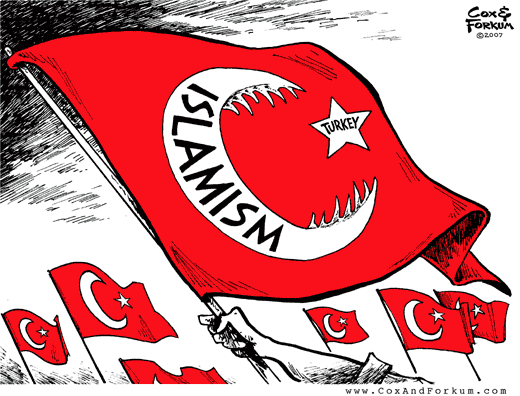
Ambitious Turkey : Reasons and tips for showing our displeasure with Ankara’s neo-Ottomanism

Daniel Pipes

A few days ago, Turkey’s foreign minister, Ahmet Davutoğlu, grandiloquently proclaimed that “if the world is on fire, Turkey is the firefighter. Turkey is assuming the leading role for stability in the Middle East.”
Such ambition is new for Ankara. In the 1990s, it contentedly fulfilled its NATO obligations and followed Washington’s lead. Starting about 1996, relations with Israel blossomed. In all, Turkish policy offered an attractive exception to the tyrannical, Islamist, and conspiracist mentality generally dominating Muslim peoples. That the country’s political leaders were corrupt and fumbling seemed of little consequence.


Those faults, however, proved extremely consequential, leading to the repudiation of long-established political parties and the victory of an Islamist party, Adalet ve Kalkınma Partisi (AKP), in the elections of November 2002. By March 2003, in advance of the coming war in Iraq, the new government signaled that a new era had begun by refusing to permit American troops to traverse Turkish territory.
Over the next eight years, Turkish foreign policy became increasingly hostile to the West in general, and to the United States, France, and Israel in particular, as it warmed to governments in Syria, Iran, and Libya. This shift became particularly evident in May 2010, when Ankara both helped Tehran avoid sanctions for its nuclear program and injured Israel’s reputation with the Mavi Marmara–led flotilla.
But the full extent of Ankara’s Middle East ambitions emerged in early 2011, concurrent with the region’s far-reaching upheavals. Suddenly, Turks were ubiquitous. Their recent activities include:
Providing a model: Gül holds that Turkey can have a “great and unbelievable positive effect” on the Middle East — and he has some takers. For example, Rached Ghannouchi, leader of Tunisia’s newly legalized Ennahda movement, has stated: “We are learning from the experience of Turkey, especially the peace that has been reached in the country between Islam and modernity.”
Offering an economic lifeline to Iran: The Turkish president, Abdullah Gül, paid a state visit to Tehran in February, accompanied by a large group of businessmen, capping an evolution whereby, according to the Jamestown Foundation, “Turkey is becoming a major [economic] lifeline for Iran.” In addition, Gül praised the Iranian political system.
Obstructing foreign efforts in Libya: Starting on March 2, the Turkish government objected to any military intervention against Moammar Qaddafi’s regime. “Foreign interventions, especially military interventions, only deepen the problem,” Davutoğlu put it on March 14, perhaps worrying about a similar intervention to protect Kurds in eastern Turkey. When military operations began on March 19, Turkish forces did not take part. Turkish opposition delayed NATO’s engagement in Libya until March 31 and then freighted it with conditions.
Supporting Qaddafi: Turkey’s prime minister, Recep Tayyip Erdoğan, helped Qaddafi by issuing both demagogic proclamations (“Turkey will never be a party that points a gun at the Libyan people”) and practical proposals (e.g., that Qaddafi salvage his rule by appointing a president). Ankara also offered, according to the Istanbul-based Hürriyet newspaper “to be involved in the distribution of humanitarian aid in Libya, to manage the Benghazi airport and to deploy naval forces to control the area between Benghazi and the Greek island of Crete.” In gratitude, Qaddafi replied, “We are all Ottomans.” In contrast, Libyan rebels fumed at and marched against the Turkish government.
Helping Damascus: In January, Ankara agreed to train Syrian troops. In March, Erdoğan publicly advised Syria’s president, Bashar al-Assad, on how to maintain power, perhaps fearful that Syria’s 1.4 million Kurds might win more autonomy and cause unrest among Turkey’s approximately 15 million Kurds.
Anti-Zionism: Ankara has emerged as the leader in delegitimizing Israel. Davutoğlu tries to unify its enemies while predicting Israel’s disappearance; a government-affiliated organization plans a new Gaza “freedom” flotilla with at least 15 ships taking part; and the deputy prime minister calls for a Libya-style bombing of Israel.
Ankara’s ambitions must be checked. Less provocatively and more intelligently than the Iranian regime, it aspires to reshape Muslim countries in its Islamist image. The opening salvos of this effort have gone well, being both effective and largely unnoticed.
Possible methods to block AKP influence include: expressing displeasure with Ankara’s “neo-Ottomanist” policies; publicly questioning whether Turkish actions are compatible with NATO membership; quietly encouraging opposition parties in the country’s June 2011 elections; and, at this moment of AKP hostility and of Kurdish uprisings in eastern Turkey, reconsidering the delicate question of Kurdish civil rights.


Daniel Pipes is director of the Middle East Forum and Taube distinguished visiting fellow at the Hoover Institution of Stanford University.


http://www.nationalreview.com/articles/264413/ambitious-turkey-daniel-pipes

Πέμπτη 10 Ιουνίου 2010

78 percent of Jewish Israelis view Turkey as enemy, poll shows


TURKEY
DIPLOMACY

Thursday, June 10, 2010
JERUSALEM — Agence France-Presse

Some 78 percent of Jewish Israelis now view Turkey, once Israel's only Muslim ally in the Middle East, as an enemy nation, according to a poll published on Thursday.

The sharp switch in public attitude toward Turkey comes in the wake of a May 31 raid by Israeli commandos on an aid flotilla bound for Gaza, which left eight Turkish activists and one Turkish American dead.

The poll, published in the pro-government Yisrael Hayom daily, asked participants: "Do you believe that in light of recent events Turkey has become an enemy state?"

It said 78 percent of those surveyed answered yes, while 22 percent said no.

In the 1990s, the two nations developed close military and economic links and have held frequent joint military drills and signed a free trade agreement. Turkey had also become a favorite holiday destination for Israelis.

But the ties have declined rapidly amid vehement Turkish criticism of the devastating offensive which Israel launched against the Gaza Strip in December 2008 and Ankara's improving ties with Tehran.

And relations virtually broke down following the flotilla raid.

Turkey recalled its ambassador and scrapped joint military drills, saying economic and defense ties with Israel would be reduced to a "minimum level."

Turkish Foreign Minister Ahmet Davutoğlu said this week that normalization of ties with Israel was out of the question if it rejects an international inquiry into the deadly raid on the aid flotilla.

The poll said that only 13 percent of Jewish Israelis favor an international commission, while 71 percent prefer an internal Israeli inquiry.

The poll by the New Wave Research group surveyed 561 people and had a margin of error of 4 percent. It did not take into account the views of Israel's Arab minority, which makes up about 1.3 million of Israel's 7.4 million citizens.

The poll also indicated that 91 percent of Jewish Israelis believed Israel should stop future flotillas trying to breach its Gaza blockade. Five percent were opposed and 4 percent had no answer, the poll said.

Israel, together with Egypt, first imposed the closures on the Gaza Strip after the capture of an Israeli soldier by Hamas and other militants in a deadly cross-border raid in June 2006 and tightened the sanctions when the Islamist group seized power in Gaza a year later.

Τετάρτη 9 Ιουνίου 2010

Gaza, Israel, Turkey, and We


from: THE ARMENIAN WEEKLY

http://www.hairenikweekly.com/
Η Γάζα, το Ισραήλ, η Τουρκία κι εμείς
Γκαρέν Γιεγκπαριάν
Garen Yegparian

http://www.armenianweekly.com/2010/06/09/yegparian-gaza-israel-turkey-and-we/

Israel screwed up in its response to the ships attempting to break its blockade of Gaza. Anything it might have gained by preventing the entry of material it chooses to exclude from Gaza is far outweighed by the international opprobrium it has garnered. But this is not at issue except by extreme spinners of pro-Israel policy. What’s more interesting for Armenians is Turkey’s role and position in all of this, and what doors are open to us as a result.

Certainly, no one doubts that Turkey’s, and its ruling AK Party’s, involvement in all this is nothing but a cynical, Machiavellian, realpolitik ploy in its devilishly competent Foreign Minister’s bag of tricks to expand the genocidal state’s international stature, and particularly among the peoples and states of the Arab and Muslim worlds. The Turkish group cooperating with the efforts may also have connections to unsavory outfits, but more on this if and when I can get details. I’m told it was very well organized and funded, and delivered the biggest ship in the relief flotilla, which suggests the possibility of state involvement. It was also the ship on which the violence occurred.

Erdogan’s and Davutoglu’s statements have received wide coverage. Clearly, this is part of their neo-Ottomanist efforts to become a player in the Islamic world, much of which shuns Turkey for the brutality and misrule heaped upon fellow Muslims under Ottoman rule and Kemalism’s anti-Islamic bent. Official Ankara seems to be making the calculation that there’s more to be gained by clashing with Israel than further developing a decades-long positive relationship.

Among the fruits of the positive relationship has been help in the halls of U.S. power, fighting passage of the genocide resolution, and other anti-Armenian efforts emanating from Azerbaijan and Turkey. The question is, after the last few incidents, are those Jewish lobby elements in the U.S. that have worked against us (and even against their more right-minded and conscience-driven colleagues) ready to come around? Do they see yet that there’s no long-term benefit to supporting a genocide-denying state? Are they irate enough to downgrade or sever the relationship? It seems to me this is a very opportune moment for our efforts in the U.S. It’s time for some renewed outreach.

Simultaneously, our colleagues in the Middle East should be conveying to their governments how untrustworthy, back-stabbing, and cynical Turkey’s recent ploys demonstrate it to be. On the non-diaspora front, Armenia’s government should be playing up similar themes with their negotiating partners, whether the issue is economics, Artsakh, or actual relations with Turkey.

But this is all short-term gain. If Turkey’s efforts bear fruit, then we will have serious problems in the long term. Remember where Armenia is situated. If Turkey pulls Iran into its orbit, it’s a problem. If the Arab countries become enamored of Turkey’s pseudo-heroics, our communities in there may become constrained. They may even get some traction in Europe with their faux-humanitarianism. It is imperative and timely to publicize the irony (and the underlying temerity) of Turkish comments about occupation (think Armenia and Kurdistan) and human rights abuses (think coddling Darfur’s butcher, abuse of its own minorities, massacres, etc.).

We have to play very hard. For the last three centuries, the Ottoman Empire/Turkey has survived through very skillful diplomacy, playing off against one another powers far greater than it, using Asia Minor’s pivotal geography. They’re using our lands to our, and the world’s, detriment. Since we’ve been deprived of statehood for all but the last century or so (and a very shaky, mostly Soviet-subservient statehood at that) we don’t have the same depth of diplomatic/political history, experience, skills, and culture to draw on. But this is a perfect time to learn by doing and pushing to the edge. There’s not much to be lost, but tremendous potential for gain.

I hope we, the diaspora and Armenia’s government (especially after the protocols fiasco), are up to the challenge. Let’s expose Turkey for the fraud that it is.

Τρίτη 8 Ιουνίου 2010

Obama unveils his national security strategy


Posted on June 7, 2010
by The Global Realm
Obama unveils his national security strategy

The Voice of Russia
Jun 7, 2010
http://theglobalrealm.com/2010/06/07/obama-unveils-his-national-security-strategy/

In the Voice of Russia World service we present a new program Red Line.


Strokan: Welcome to the Voice of Russia and its weekend program Red Line. Every weeken we, Sergei Strokan and Mira Salganik, discuss the most significant events of the week. We are joined in the discussion by Russian and foreign experts, political, academic or cultural figures sharing or opposing our views on the vast and increasingly interdependent world. We want the program to be personal, provocative and, above all, honest. Mira, it was by no means a quiet week, wasn’t it?

Salganik: Well, it was certainly not a quiet week at all. When we met here last weekend, I couldn’t imagine the coming week would be quite so turbulent and tragic also. I mean Gaza carnage and Andrei Voznesenski’s death is mourned far beyond Russia, I mean given his caliber and international popularity.

Strokan: So, here we go. Beyond the headlines – this is Red Line first heading to discuss the world mainstream event. After more than a year of deliberations, President Obama finally unveiled his much-awaited national security strategy. The document spells out ABC of American and global security as it is seen by the present US administration. This 52-page text book of Obama’s vision of the world sparked worldwide debate on what would be the impact of the new Obama’s policy on America’s standing in global developments. Let me briefly remind you the key Obama’s points. “As we fight the wars in front of us, we must see the horizon beyond them,” the document says “To get there, we must pursue a strategy of national renewal and global leadership — a strategy that rebuilds the foundation of American strength and influence.” The next observation sounds provocative and gives even more food for thought – military superiority must be maintained and the United States remains the only nation able to project and sustain large-scale military operations over extended distances, the document says. But when we overuse our military might, it says, our military is overstretched. Mira, do you believe that Obama’s national security strategy is a clear break with a notorious President Bush’s security doctrine of 2002.

Salganik: Well, I think there are few differences in substance and many in tone. But it would be wrong to say this is a break with the past. After all, U.S. interests and values are long-standing and the tools it possesses for pursuing them are stable too. For all the rhetoric or distancing, there is more continuity with Bush and other presidencies than most people perceive.

Strokan: Well, Mira you know I would prefer to make special emphasis on differences rather than continuity. At least, it gives the world another chance to look at America with different eyes.

Salganik: For some time now, it has been clear that the United States’ national security strategy needs rethinking. The September 11 attacks, the global economic crisis, cyber-terror threats and even the environmental catastrophe in the Gulf of Mexico underscore that the challenges America faces in 2010 have changed even from just a decade ago.

Strokan: Secretary of State Hillary Clinton timely calls it “smart power”. She discussed the new strategy report in her speech at the Brooklyn institutions in Washington the other day. She said the United States is moving from the direct exercise of power to what she called “a more sophisticated and difficult mix of indirect power and influence.” But we have not yet touched upon the American and world reaction to the doctrine. We were really flooded with comments this week. What do you think of it, Mira?

Salganik: Well, actually it is the timing of the document’s release which plays crucial role in American reaction to it. And the reaction is predictably mixed. for instance, Richard Fontaine as senior fellow at the Center for a New American Security, which is a nonpartisan national security think tank in Washington, writes in The Guardian: “Democrats and Republicans, particularly the neoconservative variety, have endorsed a hyperactive American foreign policy which sees every problem as an opportunity for America to exercise leadership (in other words, to call the shots). The majority of the Washington foreign policy establishment, no matter its partisan hue, tends to believe that American leadership abroad is necessary to be unlimited, no matter its financial cost or the level of domestic support.” On the other hand, the attitude of political elite seems to be at variants with what may be called the broader public opinion. Man in the street with Vietnam memory still lingering at the back of his mind, not at all happy with the too long drawn wars, terrorism, economic crisis, and now the Gulf of Mexico disaster too. That man should be supportive of President Obama’s concept of reconciling foreign policy objectives with its domestic priorities.

Strokan: To sum up the discussion, let’s ask our experts. Now we are joined by Alexander Goltz, Moscow-based military analyst and Deputy Editor-in-Chief of a weekly online journal. Alexander, you are one of those Russian analysts who are watching the evolution of American national security doctrines for nearly three decades. Do you think it would be appropriate to say that the new Obama doctrine is a radical departure from the vision of President Bush?

Goltz: It’s no doubt that the existing military doctrine is a real departure from President Bush’s concept, and it is obvious. Truly speaking, the doctrine has the same goals as the previous one – the American leadership, but instruments to promote this leadership are totally different. In President Bush’s vision, America had role of a “lonely sheriff” in the world. Obama’s approach is totally different. He wants to reach American leadership on base of different coalitions and alliances. And what is very important for me, it is not only traditional alliances such as NATO, U.S.-Japan Alliance and so on. Obama’s vision is much wider. He is speaking about coalitions of those who are important, about special relationship and cooperation with China, India and Russia, with the South African republic and Brazil. Obama is fulfilling the approach of Russian diplomats in his doctrine, except the idea of a multi-polar world.

Strokan: Well, it sounds convincing enough, thank you, Alexander. And let’s hear what an American expert says. Ivan Eland, senior fellow and director of the Center on Peace and Liberty. Mr. Eland, as President Obama spelled out his basic ideas on how to enhance national and global security, there is ongoing debate about whether this President, who came to office on a promise of changing American foreign policy, has actually delivered a new vision of U.S. role in the world. Do you agree that the new doctrine reveals Obama’s radical departure from the vision of President Bush?

Eland: I think there are important changes in the doctrine – it deemphasizes nuclear weapons and “the war on terror”, focusing on the war with al-Qaeda, which is really what the U.S. need to do now. Al-Qaeda is still too wide, with many local affiliates worldwide, like those in Iraq or in the Arabian Peninsula and perhaps the U.S. should not make more enemies. Focusing on Al-Qaeda, it is narrowing the focus from worldwide war on terror. So I think these are the changes in the doctrine. But we still have two wars going – Obama is supposed to be pulling out of Iraq, but he is also escalating Afghanistan. So, there will be now more sanctions on Iran, and perhaps later on North Korea, but this hardship policy as well resembles Bush’s. But I think basically there is certainly a new tone and in US-Russian relations Obama has made a lot of progress.

Strokan: And let me ask you another question. The new doctrine calls for comprehensive engagement with new power-centers, like Russia, China, India or Brazil, and also principal engagement with adversaries. What should be really done to make comprehensive engagement really work?

Eland: I think, in particular the case of China and Russia, the US has to give up this idea that we need to contain them, because the Cold War is still sort of going on in Europe, as well as Asia, because US still has all these alliances, both NATO over in Europe that are encroaching on Russia’s borders and in Asia with Taiwan and South Korea. I think a US ally has to blockage the containment policy of China and Russia and also its alliances, and determine if it is relevant for this post-9/11 world where we are overextended economically and militarily, because of our economic difficulties and our big budget deficit.

Strokan: I think what Mr. Ivan Eland says sounds convincing enough. And let’s come to our second heading – Between the Lines to discuss the most significant publications of the past week. Israeli newspaper “Haaretz” strikes a bit unusual tone unlike other Jewish state media criticizing the military sea operation which, according to some sources, left nearly 20 people dead and evoked unprecedented global scandal (inaudible) and international pressure on Israel mounting with every passing day. Israel has forgotten the lessons of “the Exodus”, claims Yossi Melman in “Haaretz” paper. According to Yossi Melman, despite having its eyes wide open, Israel fell into a trap. Israel knew that the organizers of the flotilla wanted to present the Israel defense forces to the world as an army that doesn’t hesitate to revert to force. The flotilla organizers wanted deaths, casualties, blood and billow smoke. This is exactly what it gave them, says “Haaretz”. According to the paper, Israel’s decision makers should have revised memories if Israel’s own history. It shows just how short is historic memory the Prime Minister, Defense Minister, Chief of Staff and Navy Commander all have. They don’t remember the story of the “Exodus” ship in 1947, says “Haaretz”. Mira, do you think this is an appropriate historic parallel at all?

Salganik: In a sense, it might be relevant to recall it. As far as I remember, 60 years ago the British mandate authorities imposed a blockade too on the shores of the land of Israel. And Jewish leaders believed it was their right. The Jewish immigrants on the ship called “Exodus” decided to forcibly oppose every attempt to stop them. Jewish leaders wanted to arouse the world consciousness and gain a victory in the battle for the international sympathy. I guess nowadays Hamas leaders attempt to employ similar tactics for similar ends. Without getting into the question of justice or logic or the blockage imposed on Gaza and its residents, it was clear that they saw it as their natural rights to oppose attempts to stop the ships.

Strokan: Mira, in 1988 when the Palestinians organized the ship named “The Return” to be sent to Israel with Palestinian refugees, Israel chose a different method to stop it. It sent Massad agents and naval commandos to Cyprus to sabotage the ship before the passengers had embarked. The ship was damaged, but no one was hurt. Israel should have considered a similar approach, but apparently, the days in which Israeli agents could operate freely in friendly countries are gone. And now we are joined by Alexander Rytov, Associate Professor with Moscow-based Institute of International Relations. Alexander, international humanitarian mission in Gaza unexpectedly turned into a bloody carnage these days. As Israel and the world community have different points of view, whose message sounds more convincing to you?

Rytov: The situation with the flotilla is really very strange and complicated, because of course there is a new factor which is involved in the story. This new factor, and very important one and very significant one is Turkey, because as far as all of us know Turkey and Israel are considered allies and friends, the friendly relations between them have very long historical roots. That is why this new engagement of Ankara into the Middle East story sounds like an absolutely new accent in the developments in the Middle East. To my mind, the flotilla formed and supported by Turkey and inspected by the Israeli commandos, is a beginning of new contradictions in the district. To my mind, it is an attempt of Turkey to show the European community that the delay in confirmation for the future association and inclusion of Turkey to the European Union and the rejection of Turkey as a possible member of the EU, can turn to the drifting of this country to the other world – to closer relations with the Arab world, to the involvement into the middle East conflict and of course ignoring the interests of its allies, which represent Europe in the Middle East. And this country is Israel. And Israel, understanding that, of course is very tough, it doesn’t want to be the Turkish argument in this dispute with the EU. It shows from the very beginning that it will never ally any country to support trends and movements and political organizations, which can represent any harm, any new problem for Israel. That’s why the sharpness and the decisiveness of the Israeli commandos was aimed, to my mind, to show Ankara that Israel should be excluded from the Turkish game, and the attempt to show the EU that Turkey can be more distant from the European values and should be associated with the Middle East conflict.

Strokan: Alexander, what role can world media play in defusing tensions?

Rytov: Of course, the media are interested in some hot news. The hot news is that it is the first maybe for many years direct clash, not only political, but also military between Israel and people presenting the project which was initiated by Ankara. This is the first serious contradiction between two countries. Of course, there were some other small diplomatic protocol incidents, some things which were not very serious. This one, with a lot of victims and with the attempt to send a second flotilla, can bring about real cooling in relations between Israel and Turkey. Of course, it will not last long, but it is one of the attempts of Turkey to show that the situation is deteriorating. And of course the mass media are discussing this story, not only as a new incident, as a new splash of the Gaza problem, but first of all, as absolutely unexpected and unique for the political developments of nowadays clash between Israel and Turkey, which is most interesting for them.

Strokan: And now let’s hear what heavyweight of Russian expert community, vice-president of Russian Jewish council and president of the Moscow-based Institute of Middle East Studies Yevgeny Satanovsky will say. The international humanitarian mission in Gaza unexpectedly turned into a bloody carnage. Mr. Satanovsky, do you think this is an attempt to compromise Israel?

Satanovsky: The problem of conflict around the so-called “Caravan of Peace” and the Israeli Army is a problem of geopolitical strategy of the Turkish Empire, new Ottoman Empire, which will be built by the Turkish government, by Prime Minister Erdogan, Minister of Foreign Affairs Davutoğlu and President Gul. It is not the question of conflict between the Palestine and Israel. So-called world community, if we name the groups of Islamists, antiglobalists, ultra-left parties form the team of the “Caravan of Peace” and the Israeli Army, is the question that in the new strategy of Ankara to be partner with Israel and be partner with Syria, Libya, Iran, the whole Islamic world and the historical territory of the Turkish Empire, is impossible (makes no sense-misture of two different sentences). In this balance of interests, Israeli-Turkish cooperation must be destroyed.

Not the last one will see much more serious conflict. The Israeli version of course is truth, but nobody is interested that this is truth, because this is the same situation which was in the Second World War with Czechoslovakia in Europe. Israel must pay its price for everything on the Middle East, from the view of Ankara, Tehran and the Muslims. All other aspects of conflict are not more than the side dish, with the main course of this military cooking is the Ankara strategy.

Salganik: Thank you, Dr. Satanovsky, it was certainly most interesting.